Gary Illyes said, ‘We have to be able to get our own signals. And if we are relying on other signals… that’s not something we control.’
Gary Illyes of Google actually responded to a question about confusing Google not using social activity as a ranking factor, emphasizing that it was about externally driven signals that aren’t controllable.
Kenichi Suzuki Interview with Gary Illyes
Kenichi Suzuki (LinkedIn profile), of Faber Company (LinkedIn profile), is a well-known Japanese search marketing expert and has been in digital marketing for at least 25 years. I saw him last speak a few years ago at a Pubcon session, and he had a research paper on sorts of attributes of sites that Google Discover had a tendency to show.
Suzuki produced an interview with Gary Illyes, and asked him a couple of questions on SEO, including this question on SEO, social media, and Google ranking factors.
Gary Illyes is an Analyst at Google (LinkedIn profile) who has a track record of delivering hassle-free answers that bust SEO myths and shock sometimes, like when he said recently that links are less of a factor to rank than most SEOs typically think. Gary was part of the web publishing community before joining Google and was even part of the WebmasterWorld forum as Methode. So, I think Gary has a sense of what being a part of the SEO community is and the importance of good information, and that is seen in his answers.
Are Social Media Shares Or Views Google Ranking Factors?
The question about social media and ranking factors was asked by Rio Ichikawa (LinkedIn profile) of the Faber Company. She asked Gary if social media views and shares were ranking signals.
Gary’s response was straightforward and with no ambiguity whatsoever. He said no. What was also interesting about his response was his explanation as to why Google doesn’t use them and will not ever use them as a ranking factor.
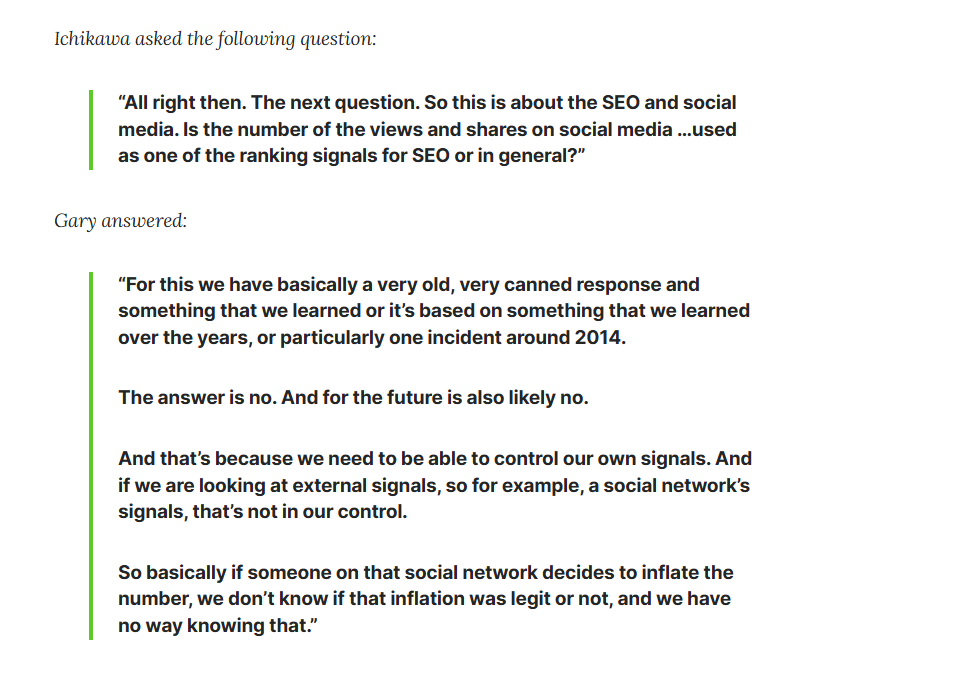
Easily Gamed Signals Can’t Be Trusted For SEO
External signals that Google does not directly control but can potentially influence via an SEO is untrustworthy. Googlers have said similar things about other signals that can easily be easily manipulated and therefore can’t be trusted for ranking signals.
To play devil’s advocate, some SEOs might ask, “If that is true, what about structured data? That is controllable by SEOs but Google uses that.” There is truth to that, as Google does use structured data, it’s not as a ranking signal; it just makes sites eligible for rich results. Additional, abusing structured data to stuff that content in that isn’t visible on the web page is against Google guidelines and could result in a manual action.
A recent example of similar vagueness in an unused protocol is the LLMs.txt protocol proposal, which is basically DOA, not only as LLMs.txt specifically has limitedusability, but because it is totally unnecessary. Google’s John Mueller has said the LLMs.txt protocol is unreliable due to the fact it provides opportunities for misuse to promote highly optimized content for ranking purposes, and that it is similar to the keywords meta tag that SEOs abused for every keyword they wanted their web pages to rank for.
Mueller said:
“To me, it’s comparable to the keywords meta tag – this is what a site-owner claims their site is about … (Is the site really like that? well, you can check it. At that point, why not just check the site directly?)”
The content in an LLMs.txt and associated files are within total control of SEOs and web publishers, which correlates with unreliability.
Another example relates to the author byline; many SEOs suggested an author byline as a means of demonstrating “authority” and influencing Google’s definition of Expertise, Experience, Authoritativeness, and Trustworthiness. Some SEOs, predictably, created fake LinkedIn profiles to link to from their fake author bio because they thought it was an authority signal. How ironic that the ease of unnecessarily abusing author bylines should have been reason to disqualify them as claims to relevancy, much less any sort of ranking-related potential.
I think the key sentence in Gary’s answer resonates with me is:
“…we need to be able to control our own signals.”
I think that the SEO community, moving forward, really needs to rethink some of the unproven “ranking signals” they think they know, like brand mentions, and just go on focusing on the things directly makes a difference, like marketing websites, and creating experiences that users love.